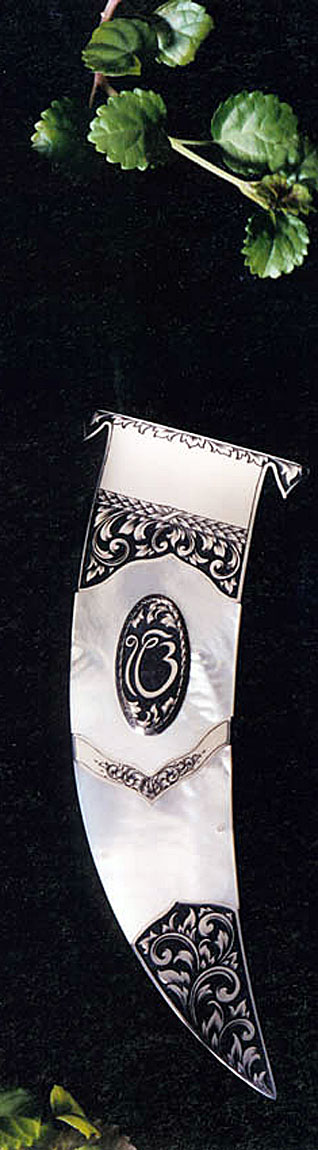
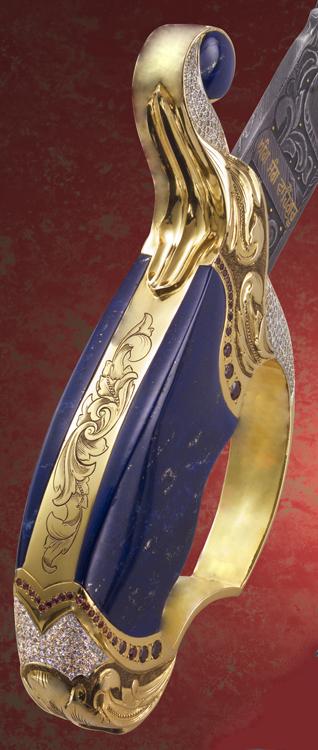
Image above, and first from bottom: courtesy - Jot Singh Khalsa.




Current Events
Desecrating the Sacred: The Eagle & The Arrow
by BHUPINDER SINGH MAHAL
April has special significance on the solar calendar. The world at large marks it as the dawn of spring.
For the Sikhs, it heralds the month known as Vaisakh, the start of a new harvest and a month to usher in their New Year and observe the founding of the Khalsa Panth.
Sikhs go to their local gurdwaras before dawn for prayers and join the nagar kirtan processions through the streets of their towns, singing hymns from the Holy Scriptures. Vaisakhi, therefore, is celebrated with gusto and devotion.
Impious acts, however, have marred the sanctity of Vaisakhi 2010.
Violence first erupted at the Sikh Lehar Centre, adjacent to the Bramsteele Road Gurdwara in Brampton (Ontario, Canada). Emotions ratcheted up when a number of outsiders turned up tp protest the role of a controversial and ostracized Sikh minstrel scheduled to lead the prayers that day. In the melee, one of the executives of the Gurdwara who came out to announce that the attendance had been canceled - Manjit Singh Mangat, a lawyer - was stabbed multiple times by a 52-year old kirpan wielding Sukhwant Singh.
A teary eyed Manjit Singh told reporter Anna Mehler Paperny: "Using a kirpan on somebody who's lying on the ground and is harmless? That is humiliating", (Globe & Mail; April 7, 2010).
On realizing the gravitas of the moment, Manjit added that it was "just one person's issue or irresponsible act".
Following on the heels of
Manjit Singh's
stabbing, a fight broke out a few days later at another gurdwara in Brampton - the Guru Nanak
Sikh Centre - over what was termed an "internal political squabble".
In anticipation of a disturbance, the gurdwara management had enlisted
help from local police. Despite that, the gurdawra meeting erupted in conflict and tempers flared up. Several devotees were assaulted with sundry weapons, including machetes.
Internecine violence is the despair of the Sikh community of Brampton. The city of Brampton, population half-a-million, sits atop Toronto. More than two of ten of its citizens is a Sikh, constituting the largest Sikh concentration in Ontario.
Now, most of Brampton's Sikhs fear similar incidents in the future.
Also, without exception, all believe in the sanctity of the kirpan but some see merit in regulating the wearing of it.
Thus, the Kirpan - one of our 'five ‘kakaars' (i.e., articles of faith), mandated to be worn by baptized Sikhs, is once again in the crosshairs this Vaisakhi time.
It has been used a few times as a weapon in a number of assaults in or around gurdwaras,
prompting Prit Pal Singh, one of the recent victims, to caution that
"People are generalizing: They're saying Sikhs are like this, they're
just militant people fighting with each other. It defeats the whole
purpose of the Gurdwara - it's supposed to be a place of peace."
Renowned Quebec lawyer, Julius Grey - who in 2001 defended the right of a 12-year old Sikh pupil to wear his kirpan in the classroom in response to the worries of some parents about their children's safety and who after protracted legal proceedings won the Supreme Court of Canada ruling allowing Khalsa Sikh students to wear a kirpan under the clothes, sewn into a sheath in the name of safety - believes these fresh incidents will raise a hue and cry about stricter regulation.
The increased wearing of the kirpan can be traced to 1984; a watershed in modern Sikh history, a time of profound calculus of religious appeal. It was a time of a great awakening. Persons who had hitherto lax attitude to the five ‘kakaars' shed their inhibitions in droves by getting baptized or adopting the full discipline of a Khalsa Sikh.
Those in middle adulthood will remember a time when only those who observed the full discipline of the faith wore the kirpan. They will also remember their parents and grandparents and those before them distinctly maintained their identity and discipline. A percentage of them wore a miniaturized replica of the kirpan which was embedded in the ‘kanga' (a wooden comb), which was securely held in the knotted hair before the tying of the turban, or hung around the neck as a pendant.
Historically, the kirpan was
a weapon made of steel. In April 1699, the Khalsa (saint-soldier) was
mandated to carry a sheathed kirpan at all times. However, changing
times and military armour made the kirpan or sword irrelevant as a
weapon
and it came to be not used a weapon, but remained an article of faith. Its wearing,
therefore,
is symbolic and its length immaterial since the length has not been
stated in any of the religious writings or the sacred text.
Front-page news of the recent kirpan assault in the gurdwara precincts is turning into a cause célèbre amongst our detractors.
If the kirpan
is a sacred symbol, then its use as a weapon is a curious paradox. And,
those who wield it to settle a dispute in or around a Gurdwara are
guilty
of a religious transgression. Personal misdeed aside, they bring shame
to the Sikh collectivity. At the same time they give outsiders the
impression
that violent behaviour is endemic to the Sikhs. Mainstream Canadian
sees the assaults as a law and order issue and their outrage is
palpable.
Many in the community appear oblivious to the self-inflicted damage, evoking Aesop's fable of the eagle and the arrow.
An archer from a place of concealment saw an eagle swoop down on its prey and took an accurate aim and wounded it mortally. The eagle looked at the arrow and saw its fletching made from feathers that once belonged to the eagle. The eagle exclaimed: "It is a double grief to me that I should perish by an arrow feathered from my own wings".
Likewise, unless the Sikh collectivity faces the difficult situation over the misuse of the kirpan and grapples with it and finds an in-house solution, the stringent safety regulations that Julius Grey fears will come to pass.
April 23, 2010
Conversation about this article
1: Randeep Singh (Canada), April 24, 2010, 3:37 PM.
The kirpan was important at that time when every Sikh was asked by Guru Ji to wear it. Is it that important now in these changed times? Just a thought.
2: Mai Harinder Kaur (Seattle, U.S.A.), April 24, 2010, 4:34 PM.
An excellent article. I agree with most of what was written here. I do take issue, though, with one statement: "However, changing times and military armour made the kirpan or sword irrelevant as a weapon and it came to be not used a weapon, but remained an article of faith." My kirpan - the blade is smallish dagger-length - is sharp and I have had occasion to use it in self-defence several times, most notably in Delhi during the 1984 anti-Sikh pogroms. I have often wondered how many Sikh lives could have been saved if more amritdhari Sikhs had had such kirpans and knew how to use them effectively. The fact that I am alive to write this is proof that the use of the kirpan as a defensive weapon is not irrelevant.
3: Ab Mohammed (Vancouver, British Columbia, Canada), April 26, 2010, 5:52 AM.
This is an excellent article as it does give some insight into one of Sikhism's basic tenets as well. Although I am not a religious person, I do understand and appreciate religious symbolism. And, by the way, if someone was attacked and injured with a large metal crucifx, would that call for the banning of all crucifixes in public places? I hope not!
4: Jodh Singh (Jericho, New York, U.S.A.), April 27, 2010, 3:43 PM.
Very sound opinion of Mr. Mahal, but I agree with Mai H. Kaur that this was very useful in Delhi Cantt. in 1984. A group of Hindus tried to attack the Sadar Bazar area; out came a few Sikhs with kirpans and some of them knew gatka. Seeing Sikhs in a defense posture with lalkaaras, the attackers ran away. No damage was done in Delhi Cantt. But I also feel bad that a young Sikh stabbed an Indian and he is in jail. Another Sikh used a kirpan in a New Jersey gurdwara and it caused closure of the gurdwara. My prayer to kirpandhari Sikhs is not to unsheath the kirpan under any circumstances; it may lead to its ban.